NAS hard drive prices nearly doubled - the data (Q3 2026)
NAS hard drive prices sat flat for a year, then roughly doubled per terabyte as the AI datacenter buildout swallowed hard-drive supply. Here's the $/TB trend, when it turned, consumer vs enterprise, and how to time a buy.
If you priced a NAS build a year ago and again today, you already know the punchline: the drives got more expensive, and it wasn't your imagination. For most of 2024 and well into 2025, the price of NAS hard drives per terabyte barely moved. Then it climbed - and it hasn't come back down.
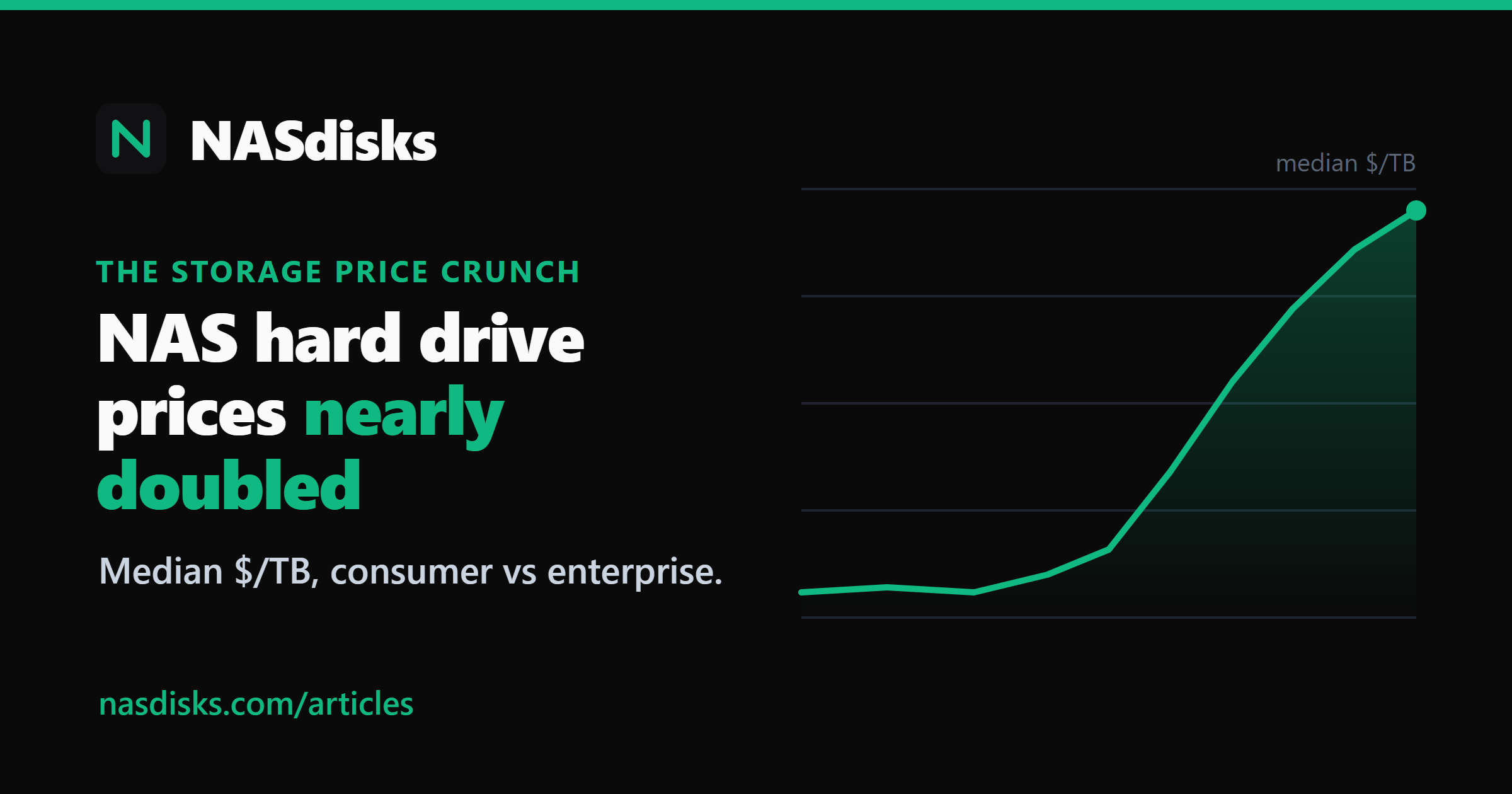
This is the whole story in one chart. It's the monthly median dollars-per-terabyte across every in-production 8TB-and-up NAS hard drive we track, split into the two tiers most people actually choose between: consumer NAS drives (the WD Red and Seagate IronWolf class) and enterprise drives (Exos, MG, Ultrastar). Hover any month to read both tiers; drag to zoom a stretch.
Two things stand out. First, the climb is real and it's large - not a rounding error or a single bad month; the typical NAS drive roughly doubled in price per terabyte. Second - and this is the part that surprised me - the two tiers moved as one. Consumer and enterprise drives sat within a dollar or two of each other per terabyte before the crunch, and they still do at the top. There was no cheap tier that escaped and no premium tier that got hit harder. The whole market went up together.
When it turned
The most useful thing about a daily price history is that it dates the turn. And the turn is sharp. For more than a year - through 2024 and most of 2025 - the median sat flat, hovering around the low twenties of dollars per terabyte, drifting a dollar up or down with normal sales noise. If you'd bought in that window, you paid roughly what everyone before you had paid.
The line breaks out of that band in late 2025. From there it climbs in almost every month: a few dollars per terabyte at first, then bigger steps through the winter, then a steep run into spring 2026 that clears $40/TB - a level the median had never been near. By mid-2026 it plateaus high rather than falling back. The pattern is textbook supply shock: a long flat stretch, a fast repricing, and a new, higher floor that sits there.
That shape matters for how you read today's prices. This isn't a market bouncing around a stable average that you can wait out. It's a market that reset to a new level.
What's driving it
The short version: AI. The buildout of AI datacenters pulled an enormous amount of storage demand forward, and hard drives - still the cheapest way to store bulk data at scale - got swept up in it.
A few forces compounded:
- Nearline demand exploded. Hyperscalers buy high-capacity "nearline" drives by the pallet for the storage tier behind all that compute. When they pre-buy years of capacity, the supply that would otherwise reach retail tightens fast.
- Only three makers. There are effectively three hard-drive manufacturers left - Seagate, Western Digital and Toshiba. There's no fourth supplier to soak up a demand spike, and new platter capacity (the HAMR transition included) comes online slowly and deliberately, not overnight.
- Flash didn't bail anyone out. The same AI wave squeezed NAND and DRAM, so "just buy SSDs instead" got more expensive too, and some bulk workloads that might have drifted to flash stayed on disk - keeping HDD demand high.
It's the same squeeze that hit the rest of the hardware stack, just slower to show up in the aisle you shop in. Flash and DRAM moved first; spinning disks, with longer supply chains and fewer manufacturers, moved next.
What it does to a build
Per-terabyte percentages are easy to wave away until you put them on a real build. Take a four-bay NAS you want to fill with 16TB drives - a middle-of-the-road homelab setup. At the pre-crunch median of roughly $20/TB, those four drives ran about $1,300. At today's level, closer to the mid-$40s per terabyte, the same four drives are around $2,800. Same NAS, same capacity, roughly double the drive bill - and that's before you add the spares a sensible RAID plan wants.
That's the practical sting: the crunch didn't just nudge a spec-sheet number, it changed what a normal build costs by four figures.
Consumer vs enterprise: which tier makes sense now
Here's the myth this data busts, and it comes with an asterisk we'll get to: "just buy enterprise drives, they're cheaper per terabyte." Among new drives - which is all we price here - that isn't true. Across our median of in-production 8TB+ drives, the consumer NAS and enterprise lines have tracked within a dollar or two of each other the whole way, before the crunch and through it. A specific discounted Exos can still be the single cheapest terabyte on the shelf, but as a tier, new enterprise is not a standing $/TB discount over new consumer NAS drives.
Matched capacity by capacity, it's a coin flip - consumer wins at some sizes, enterprise at others, depending on which model is on a good price that week:
| TB | Consumer NAS cheapest $/TB |
Enterprise cheapest $/TB |
Cheaper (new) |
|---|---|---|---|
| 8 | C$49.37 | C$43.14 | Enterprise |
| 10 | C$59.91 | - | - |
| 12 | C$49.58 | C$62.46 | Consumer |
| 14 | C$61.43 | C$56.68 | Enterprise |
| 16 | C$46.87 | C$54.92 | Consumer |
| 18 | C$60.00 | C$29.87 | Enterprise |
| 20 | C$49.75 | - | - |
| 22 | C$63.64 | C$49.58 | Enterprise |
| 24 | C$49.58 | C$54.09 | Consumer |
Read down that table and there's no clean winner. The single cheapest terabyte on the board right now is an enterprise drive at high capacity - but at more capacities than not, the cheapest new drive is actually the consumer one, and where enterprise wins it's usually by a couple of dollars per terabyte, not a landslide. "Buy enterprise, it's cheaper" isn't a rule; it's a per-model, per-week coincidence.
So if price per terabyte doesn't separate the tiers, what does?
- Noise and power. Enterprise drives are louder and draw more power. In a closet or basement rack, nobody cares. Next to your desk, you will.
- Warranty and support. Consumer NAS drives are sold for exactly this use; enterprise drives bought through consumer channels can be a warranty grey area.
- Reliability is basically a tie. This is the part people get wrong. Across mainstream CMR drives, real-world failure rates are close enough that you can't honestly rank them apart - the Backblaze fleet average sits around 1.4% annualized, and the confidence intervals overlap heavily. You are not buying meaningfully better reliability by paying more between comparable CMR drives.
So the tier decision comes down to where the drive lives and what you value, not to a price-per-terabyte edge or a reliability leaderboard.
What about cheap recertified enterprise drives?
This is the asterisk, and it's the real reason "enterprise is cheaper" persists. It's true - but not for new enterprise drives. It's true for recertified and refurbished enterprise drives: pulled or returned datacenter Exos, Ultrastar and MG drives, wiped, re-tested, and resold. Those routinely land around $10-15/TB, roughly a third of the cheapest new drive of any kind. Nothing new - consumer or enterprise - comes close.
We don't price those here, on purpose. They're sold by specialist resellers rather than as standard new retail listings, so they sit outside the clean, new-in-stock pricing this site tracks. And they're a genuinely different buy:
- Warranty is short and reseller-backed (often 2-5 years from the seller, not the manufacturer), not the 5-year manufacturer warranty on a new drive.
- The drive has prior hours. A good reseller reports SMART data and power-on hours; a bad one doesn't. Check them on arrival.
- No retail return path. You're trusting the reseller's testing and RMA process.
For a lot of homelab builders those tradeoffs are worth it, especially with redundancy that can absorb a failure - it's the same logic as shucking. Just know you're comparing recert enterprise against new drives, not enterprise against consumer. The tier isn't what makes it cheap; the "recertified" label is.
Will prices come back down?
Probably not to where they were, and not soon. Supply-constrained prices don't snap back the way a holiday markdown does. The demand driving this - datacenter storage for the AI buildout - is structural, not a seasonal blip, and the supply side can't turn on a dime: three manufacturers, capacity that ramps in careful steps, and a HAMR transition that adds terabytes gradually rather than flooding the market.
The realistic best case isn't a rollback, it's a plateau - prices holding near this new level, with real (but smaller) sale-driven dips inside it, and the slow long-run drift back down that higher-capacity drives always eventually bring. Planning your build around a return to 2024 pricing is planning around a wish. Planning around "this is roughly the floor now, so buy smart at this level" is planning around the data.
When to buy
You can't time the bottom of a supply crunch, but you can avoid overpaying:
- Buy on $/TB, not sticker price. A 16TB drive that looks expensive can be cheaper per terabyte than the 8TB that looks cheap. Sort by $/TB, not by the number on the box - our full table and best-value-by-capacity report do this for you.
- Shop the capacity sweet spot. The lowest $/TB usually sits a notch below the biggest drive on the shelf, where volume is high and the "newest, largest" premium hasn't landed. That sweet spot drifts upward over time; today it's in the mid-to-high teens of terabytes for most builds.
- Avoid SMR by accident. SMR drives are cheaper per terabyte and terrible in a parity/RAID array. Price pressure tempts people toward them. Check the SMR list before you buy - a cheap SMR drive that chokes a rebuild is the most expensive drive you can own.
- Weigh recertified enterprise honestly. If the warranty and prior-hours tradeoffs are acceptable to you and your array has redundancy to spare, recert is the one place the crunch barely reached. Buy from a reseller that reports SMART data, and test on arrival.
- Watch actual drops, don't wait for a crash. Real discounts still happen inside this higher band. Our deals feed tracks genuine price drops off each drive's own recent history, sorted biggest-first - that's a real saving; a return to old pricing probably isn't coming.
- Buy what you need now, not a hoard for later. If prices aren't snapping back, there's no bargain in waiting, and no bargain in buying years of capacity you won't use for ages. Buy the array you need, leave bays free, expand when you actually fill it.
The bottom line
The crunch is real, it hit consumer and enterprise drives alike, it dates to late 2025, and it's supply-driven rather than a passing markdown. That doesn't change the buying rules - it sharpens them. Buy on price per terabyte, keep SMR out of your array, treat reliability between comparable CMR drives as a wash, consider recertified enterprise if the tradeoffs suit you, and buy the capacity you need rather than waiting for a rollback the supply picture doesn't support.
Method
The chart is the monthly median dollars-per-terabyte across in-production NAS hard drives of 8TB and up, computed from our daily price history. We take a per-drive average within each month first, so a drive with more logged days doesn't outweigh one with fewer, then take the median across drives - robust to the set of drives changing over time. "Consumer" is the NAS and NAS-Pro classes; "Enterprise" is datacenter drives. The capacity-matched table shows the cheapest in-stock new drive per capacity in each tier, live from our catalogue - recertified/refurbished drives are excluded. Failure-rate context comes from Backblaze Drive Stats. Explore the underlying data in the full filterable table or the open dataset.